
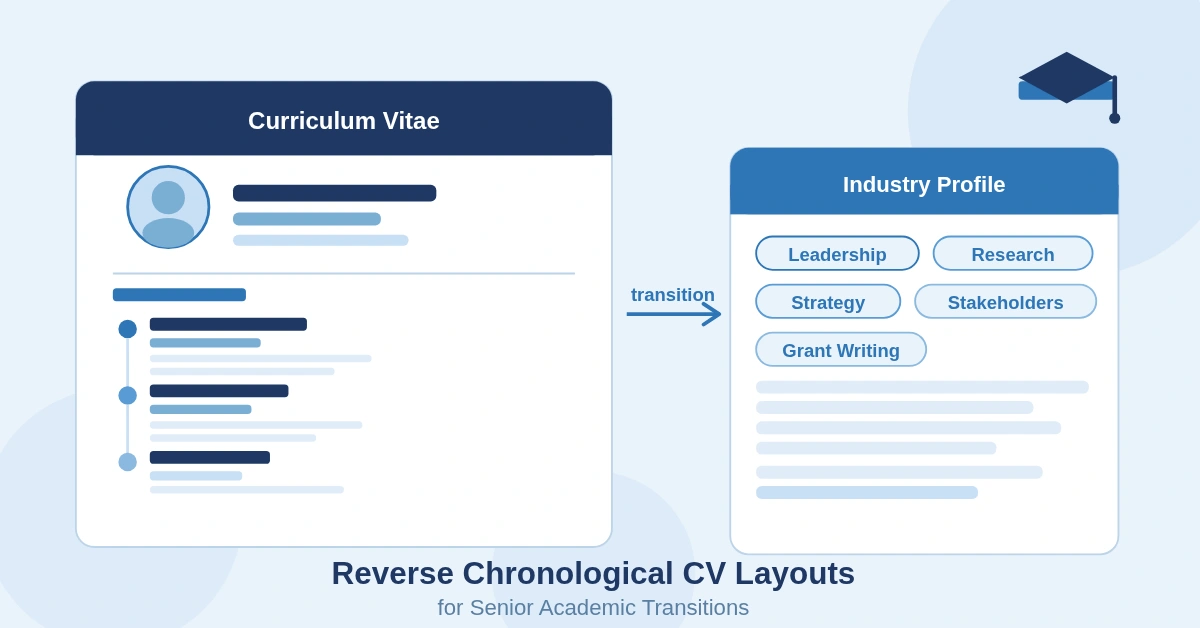
Thinking about leaving academia but not sure how to show all those years of research and teaching on a CV? You’re not alone. Many senior academics struggle to present their experience in a way that speaks to employers outside the university world. The good news? A well-structured reverse chronological CV layout can do exactly that.
Reverse chronological CV layouts for senior academic transitions put your most recent work first. That’s what hiring managers want to see. It shows where you are now not where you started 20 years ago.
In this guide, I’ll walk you through the 8 best reverse chronological CV layouts that work specifically for senior academics moving into industry, government, policy, or leadership roles. By the end, you’ll know exactly which format suits your goals and how to set it up.
What Is a Reverse Chronological CV Layout?
A reverse chronological CV lists your work history starting with your most recent role and works backward. So your current or latest position comes first. Your earliest job maybe a teaching assistant role from grad school comes last.
This is the most widely used CV format in the US and UK. Employers and applicant tracking systems (ATS) software that scans CVs before a human reads them are built to read this structure. That alone is a big reason to use it.
| Quick Note: Applicant tracking systems scan over 75% of CVs before a hiring manager ever sees them. A clear reverse chronological layout helps you pass that first filter. |
Why Reverse Chronological CV Layouts Work Best for Senior Academic Transitions
When you’re making an academic-to-industry shift, your most recent achievements carry the most weight. A Department Chair or Full Professor title held today is far more relevant than a postdoc from 15 years back. The reverse chronological format puts that front and center.
Here’s what I’ve seen work with the academics I’ve helped: employers outside academia don’t always understand academic job titles. But they do understand leadership, budgets, teams, and outcomes. A reverse chronological layout lets you lead with your strongest, most recent evidence of those things.
Key Benefits for Senior Academics
- Shows career progression clearly from lecturer to professor, or research fellow to department head
- Highlights recent, relevant leadership roles first
- Makes it easy for ATS software to parse your work history
- Works across all industries: consulting, government, nonprofits, healthcare, tech
- Meets employer expectations in both the US and UK job markets
ALSO READ ABOUT : Top 10 Sections Every Professional CV Must Have (Simple Guide for Students)
The 8 Best Reverse Chronological CV Layouts for Senior Academic Transitions
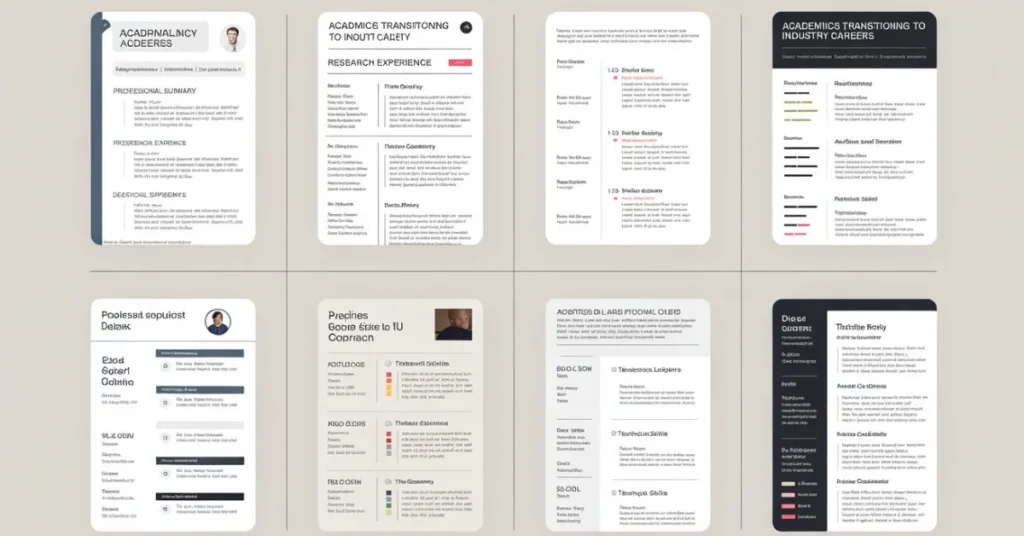
Not all reverse chronological layouts are the same. These 8 options are tailored for academics with 10–30+ years of experience making a move out of or within higher education.
Layout 1: The Classic Clean Layout
This is the gold standard. It uses two columns: left for dates, right for role titles, institutions, and bullet-point achievements. It’s clean, easy to scan, and ATS-friendly.
Best for: Academics moving into corporate, consulting, or policy roles.
| Pro Tip: Use action verbs at the start of each bullet: ‘Led,’ ‘Managed,’ ‘Secured,’ ‘Published,’ ‘Advised.’ Avoid starting with ‘Responsible for…’ it sounds passive and weak. |
Layout 2: The Executive Summary Layout
This version starts with a 3-5 line professional summary at the top. It gives the reader a quick snapshot of who you are and what you bring. Then the reverse chronological work history follows below.
Best for: Professors targeting senior leadership, director, or VP-level roles in industry.
Layout 3: The Skills-Integrated Layout
Here, each job entry includes a short list of relevant skills next to your achievements. It bridges your academic language with industry keywords like turning ‘principal investigator’ into ‘project leadership’ or ‘grant writing’ into ‘funding acquisition.’
Best for: Academics applying to roles in R&D, data science, or research management.
Layout 4: The Research-to-Industry Bridge Layout
This layout keeps your research history but frames it in business terms. Instead of listing papers, you highlight outcomes: ‘Produced research cited 400+ times that shaped national policy on X.’ Numbers matter here.
Best for: Scientists, social researchers, or healthcare academics transitioning to private sector roles.
| Common Mistake: Don’t just list publications. Non-academic employers don’t know journal impact factors. Translate your research into real-world impact instead. |
Layout 5: The Teaching-to-Training Layout
If you’ve spent years teaching, you have serious L&D (learning and development) skills. This layout reframes your teaching experience as corporate training, curriculum design, and performance coaching.
Best for: Academics moving into HR, training, corporate education, or edtech companies.
Layout 6: The Compact Two-Page Layout
Senior academics often have CVs running 10–15 pages. For most non-academic jobs, two pages is the max. This layout compresses your career into a tight, two-page format without losing the essentials.
Best for: Anyone applying to roles in government, think tanks, or private companies where brevity is expected.
| Quick Note: In the UK, most employers expect a two-page CV. In the US, two pages is standard for senior professionals. An academic-length CV will likely get ignored outside academia. |
Layout 7: The Portfolio-Linked Layout
This modern layout includes short URLs or QR codes linking to key outputs a published report, a TED-style talk, a major project. It keeps the CV tight while showing depth.
Best for: Academics in creative, digital, communications, or media-adjacent fields.
Layout 8: The Hybrid Reverse Chronological Layout
This format blends a functional skills section (3-4 core competency areas) at the top with a full reverse chronological work history below. It lets you highlight transferable skills upfront, then prove them with your history underneath.
Best for: Academics with non-linear careers or those moving into a very different sector, like an English professor moving into UX writing or a biologist moving into biotech.
Quick Comparison: Which Layout Should You Use?
| Layout | Best For | Top Sector |
| 1. Classic Clean | All senior academics | Corporate / Consulting |
| 2. Executive Summary | Directors, VPs, Leaders | Industry / Government |
| 3. Skills-Integrated | Researchers, Data experts | R&D / Tech |
| 4. Research-to-Industry Bridge | Scientists, Social researchers | Private Sector |
| 5. Teaching-to-Training | Career educators | HR / Edtech |
| 6. Compact Two-Page | Everyone (non-academic roles) | All sectors |
| 7. Portfolio-Linked | Creative / Digital fields | Media / Comms |
| 8. Hybrid | Non-linear career paths | Cross-sector |
ALSO READ ABOUT : Top 10 Skills to Include in a Digital Marketing CV
How to Choose the Right Reverse Chronological CV Layout
Here’s a simple way to decide. Ask yourself three questions:
- What industry am I targeting? Corporate and government roles want clean, concise layouts. Creative roles can handle something more visual.
- How linear is my career? If you’ve moved steadily up in one field, Layout 1 or 2 works perfectly. If you’ve jumped around, try Layout 8.
- Am I applying in the US or UK? The UK expects two pages, no photos, no personal details. The US is similar but slightly more flexible on length for senior roles.
A real example: Dr. James, a 52-year-old history professor in London, used Layout 6 (Compact Two-Page) when applying for a think tank policy director role. He cut his 14-page academic CV to two pages. He got three interviews in the first month. The format wasn’t magic — but it made his experience readable for non-academic eyes.
Common Mistakes to Avoid in Your Academic CV Transition
- Using your full academic CV unchanged this is the number one error I see
- Leading with publications instead of leadership and outcomes
- Using academic language like ‘pedagogy,’ ‘epistemology,’ or ‘corpus analysis’ without explanation
- Ignoring keywords from the job description ATS systems will filter you out
- Making the CV longer than two pages for non-academic roles
- Leaving out quantified results ‘Managed a team’ is weak; ‘Led a team of 12 that secured £2M in funding’ is strong
| Common Mistake: Listing every publication, conference, and committee role from the past 20 years. For industry roles, pick your top 3-5 achievements and focus there. Less is genuinely more. |
Step-by-Step: How to Build Your Reverse Chronological CV for an Academic Transition
- Start with your contact details name, email, LinkedIn URL, location (no full address needed in the UK or US).
- Write a 3-5 line professional summary at the top. State your role, years of experience, and top transferable skill.
- List your roles in reverse order. Start with your current position. Include institution name, dates, and 3-5 bullet points per role.
- Translate academic language into industry terms. ‘Grant writing’ = ‘Funding acquisition.’ ‘Curriculum design’ = ‘Training programme development.’
- Add a condensed Education section degree, institution, year. You don’t need to list every module or dissertation title.
- Include a short Skills section (8-12 skills, industry-relevant).
- Add a Selected Publications or Research Impact section — keep it to 3-5 items maximum.
- Proofread with Grammarly and ask a non-academic friend to read it. If they can’t follow it easily, simplify further.
| Pro Tip: Mirror the language in the job posting. If the job says ‘stakeholder engagement,’ use those exact words in your CV. ATS systems often match specific phrases. |
FAQ Reverse Chronological CV Layouts for Senior Academic Transitions
How long should a senior academic’s CV be for industry roles?
For non-academic roles in the US and UK, keep it to two pages. Senior professionals can sometimes stretch to three, but anything longer risks being skipped. Be ruthless: if a detail doesn’t support the job you want, cut it.
What is the best CV format for academics leaving academia?
The reverse chronological format is the best choice for most senior academics. It highlights your most recent roles first, which is what industry employers look for. Pair it with a strong professional summary and translated achievements to make the biggest impact.
Is a reverse chronological CV better than a functional CV for academic transitions?
Yes, for most cases. Functional CVs which group skills rather than list jobs in order are viewed with suspicion by many hiring managers. They often wonder what you’re hiding. A reverse chronological layout is more trusted and ATS-friendly.
Should I include all my publications on my industry CV?
No. Include only your top 3-5 most relevant publications or frame them as ‘research impact’ with real-world outcomes. Industry employers don’t evaluate journal impact factors. Show them what your work changed or delivered in the real world.
Can I use a reverse chronological CV for both US and UK applications?
Yes. The format works in both markets. Just note: UK CVs don’t include photos or personal details like age or marital status. US CVs also skip those. Keep both versions to two pages, and adjust your professional summary slightly for each market’s tone.
How do I translate academic experience into industry language?
Focus on outcomes, not activities. ‘Teaching 200 undergraduates’ becomes ‘Designing and delivering learning programmes for 200+ participants.’ ‘Securing research funding’ becomes ‘Acquiring £500K in competitive funding.’ Use the job description’s vocabulary as your guide.
What sections should a senior academic include in a transition CV?
Include: professional summary, work history (reverse chronological), education, selected research impact, skills, and optionally a brief leadership or board membership section. Drop: full publication lists, conference presentations, teaching evaluations, and committee memberships unless they’re directly relevant.
Ready to Make Your Move? Here’s What to Do Next
Making the shift from senior academia to a new sector is a big step but a very achievable one. The right CV format makes a real difference to how you’re perceived before you even walk into a room.
Here are the three biggest things to take away: First, always use a reverse chronological layout it’s what employers and ATS systems expect. Second, translate your academic achievements into outcomes and industry language. Third, keep it to two pages and lead with your most recent and relevant experience.
Start with Layout 1 (Classic Clean) or Layout 6 (Compact Two-Page) if you’re unsure. These work across almost every sector and are safe choices for both US and UK applications.
Now open a blank document, pick your layout, and start rewriting your story in language the world outside academia will understand and value.