
You’ve decided to go into digital marketing great choice. But now comes the tricky part: what exactly do you put on your CV?
Most students either list too little (“I know social media”) or too much (a wall of buzzwords that says nothing). Both mistakes can cost you the interview.
This guide walks you through the top 10 skills to include in a digital marketing CV with real examples, honest tips, and zero fluff. By the end, you’ll know exactly what to add, how to phrase it, and what recruiters actually look for.
Let’s get into it.
Why Your Digital Marketing CV Skills Section Matters
Here’s something most students don’t know: recruiters spend an average of 7 seconds scanning a CV before deciding whether to read it properly. Seven seconds.
That means your skills section can make or break your chances fast. A well-structured list of relevant digital marketing skills tells the recruiter, “This person knows what they’re talking about.”
It also helps your CV pass ATS (Applicant Tracking Systems). These are tools companies use to filter CVs automatically. If your CV doesn’t include the right keywords, it might never reach a human eye.
So yes, your skills section matters a lot. Let’s fill it with the right stuff.
| Pro Tip: Always match your skills to the job description. If the listing says “Google Analytics experience preferred,” make sure that’s on your CV. |
ALSO READ ABOUT : Best 14 Resume Formats for Freshers in 2026 Pakistan
Top 10 Skills to Include in a Digital Marketing CV
Here are the ten skills that recruiters look for most — especially when hiring junior marketers and fresh graduates.
1. Search Engine Optimisation (SEO)
SEO is the practice of making content rank higher on Google and other search engines. It’s one of the most in-demand skills in digital marketing right now.
Even basic SEO knowledge sets you apart. Things like keyword research, on-page optimisation, and understanding search intent are genuinely useful — and learnable for free through tools like Google Search Central.
- Keyword research using free tools (Ubersuggest, Google Keyword Planner)
- On-page SEO (title tags, meta descriptions, headings)
- Basic understanding of backlinks and domain authority
| Quick Note: You don’t need to be an expert. Even saying “Familiar with on-page SEO and keyword research” shows awareness that recruiters appreciate in entry-level candidates. |
2. Social Media Marketing
Nearly every business has a social media presence. Knowing how to grow an audience, write engaging posts, and understand platform-specific content is a real skill.
Don’t just write “social media” — be specific. Mention which platforms you’ve used and what you’ve done on them.
- Content creation for Instagram, LinkedIn, TikTok, or Facebook
- Community management and audience engagement
- Understanding of platform algorithms and best posting times
3. Content Writing and Copywriting
Marketing runs on words. Blog posts, email subject lines, ad copy, website pages — all of it needs someone who can write clearly and persuasively.
Copywriting is writing designed to get a response (click, buy, sign up). Content writing is broader and includes articles, guides, and educational pieces. Both are valuable.
- Blog and article writing
- Writing CTAs (calls-to-action) and ad copy
- Adapting tone for different audiences and platforms
4. Google Analytics (or GA4)
Data is everything in digital marketing. Employers want to know you can look at numbers and understand what they mean.
Google Analytics 4 (GA4) is the current version of Google’s free analytics tool. It tracks website traffic, user behaviour, and campaign performance. Google offers a free certification for this — I’d recommend getting it before you apply for jobs.
- Reading traffic reports and understanding key metrics
- Setting up goals and conversion tracking
- Interpreting campaign performance data
| Pro Tip: Add “Google Analytics Certified” to your CV. It takes a few hours and is completely free via Google Skillshop. Recruiters notice it. |
5. Email Marketing
Despite what people say, email is not dead. It has one of the highest ROIs (Return on Investment) of any digital marketing channel — around £36 for every £1 spent, according to industry benchmarks.
Knowing how to build an email list, write a good subject line, and segment an audience is a genuinely useful skill — even at entry level.
- Writing email campaigns and newsletters
- Understanding open rates, click-through rates, and A/B testing
- Familiarity with tools like Mailchimp or HubSpot
6. Paid Advertising (PPC)
PPC stands for Pay-Per-Click. It’s when a business pays for ads on Google, Facebook, or Instagram. Every time someone clicks the ad, the business pays a small fee.
You don’t need years of experience here. Even completing Google Ads or Meta Blueprint courses shows you understand the basics — and that initiative impresses recruiters.
- Basic understanding of campaign structure and bidding
- Google Ads and Meta (Facebook/Instagram) Ads
- Understanding ad targeting and audience segmentation
7. Graphic Design Basics (Canva)
You don’t need to be a designer. But knowing how to create clean, on-brand visuals using tools like Canva is genuinely useful in most marketing roles.
Most small and medium-sized businesses don’t have a dedicated designer. If you can create a decent social media graphic or presentation, you’re already ahead of most candidates.
- Creating social media graphics and branded content
- Understanding colour, typography, and layout basics
- Canva or Adobe Express (beginner-friendly tools)
8. Video Content and Editing
Short-form video is dominating social media right now. TikTok, Instagram Reels, and YouTube Shorts are where attention lives in 2025.
Even basic video editing skills trimming clips, adding captions, using CapCut or DaVinci Resolve — are worth listing on your CV if you have them.
- Short-form video creation (Reels, TikToks, Shorts)
- Basic video editing with CapCut, DaVinci Resolve, or Premiere Rush
- Writing scripts and captions for video content
9. CRM and Marketing Automation Tools
CRM stands for Customer Relationship Management. Tools like HubSpot, Salesforce, or Zoho help businesses manage their relationships with customers and automate marketing tasks.
You don’t need expert-level knowledge. Mentioning that you’ve used HubSpot Free, explored Mailchimp automations, or completed a CRM course shows genuine curiosity — which employers value.
- Basic use of HubSpot, Zoho, or similar CRM tools
- Understanding of marketing automation workflows
- Lead generation and nurturing concepts
10. Data Analysis and Reporting
Marketing without data is just guessing. Employers want people who can look at a spreadsheet or dashboard and tell a story about what’s working and what isn’t.
Excel and Google Sheets are enough to start. Knowing how to build a simple report, use pivot tables, and visualise data with charts puts you ahead of most junior candidates.
- Google Sheets / Excel for data organisation
- Creating simple dashboards and performance reports
- Understanding key digital marketing KPIs (traffic, leads, conversions, ROI)
Hard Skills vs. Soft Skills What’s the Difference?
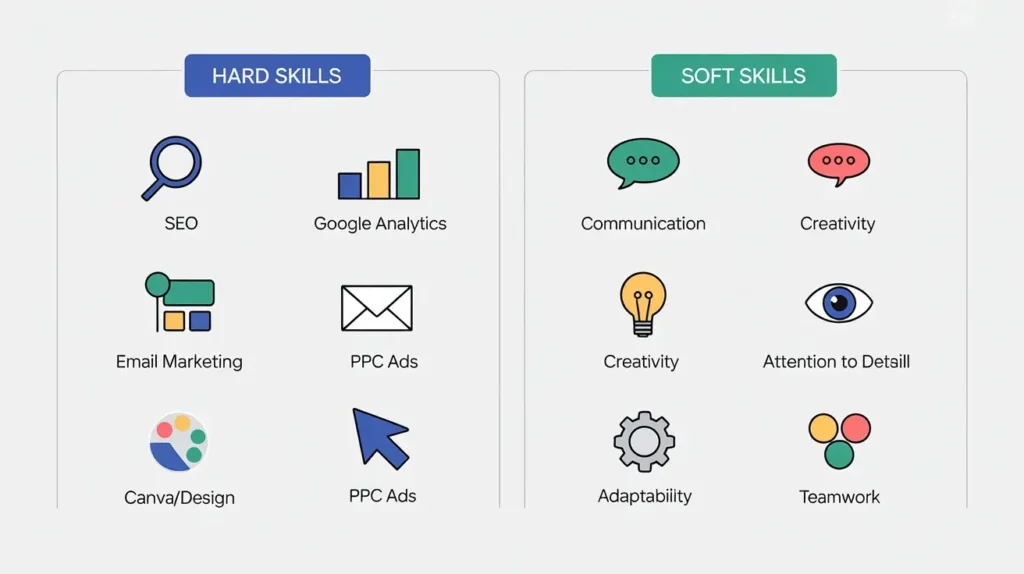
Hard skills are technical things you can learn and measure like using Google Analytics, writing copy, or running a Facebook ad. Soft skills are personal traits like communication, creativity, or time management.
Both matter in digital marketing. Here’s a quick breakdown:
| Hard Skills (Technical) | Soft Skills (Personal) |
| SEO & keyword research | Creativity & storytelling |
| Google Analytics | Communication |
| Email marketing tools | Attention to detail |
| Paid advertising (PPC) | Adaptability |
| Canva / video editing | Teamwork & collaboration |
A good digital marketing CV includes a mix of both. List your hard skills in a dedicated skills section, and let your soft skills show through your experience descriptions.
How to List Digital Marketing Skills on Your CV
This is where most students get it wrong. They dump every skill into a list and hope for the best. Here’s a smarter approach.
- Be specific — don’t just write “SEO.” Write “On-page SEO, keyword research using SEMrush and Ubersuggest.”
- Include tools — mention the actual software. “Familiar with Google Analytics 4, Mailchimp, and Canva” tells a recruiter more than “data and design skills.”
- Back it up — if you list a skill, be ready to talk about it. Even basic experience from a personal project or university assignment counts.
- Match the job description — read the listing carefully. Use similar phrasing where it’s accurate.
- Keep it honest — don’t claim expert-level skills you don’t have. Recruiters will ask about them.
| Common Mistake: Listing “Microsoft Office” as a key digital marketing skill. Everyone has it. It wastes space. Use that line for something more relevant. |
Skills Students Often Forget to Add
Here are some underrated skills that actually impress recruiters and that most students overlook:
- WordPress basics — many businesses run blogs and websites on WordPress. Knowing how to publish a post, add a meta description, or install a plugin is genuinely useful.
- Google Search Console — this free tool shows how a website performs in search. Mentioning it shows you understand SEO at a technical level.
- Hashtag research and social listening — understanding how to find trending topics and track brand mentions is a real skill.
- Basic HTML/CSS — you don’t need to be a developer. But knowing how to bold text in a code editor or fix a broken link in a CMS is a bonus many students don’t list.
- A/B testing mindset — understanding that you test two versions of something (an email, an ad, a landing page) to see which performs better shows analytical thinking.
Real Example: A Student CV That Got Noticed
A friend of mine a final-year business student spent months applying for digital marketing internships with a generic CV. She listed things like “good communicator” and “hard worker.” She heard nothing back.
We rewrote her skills section together. Instead of vague phrases, we listed: “SEO content writing (published 4 blog articles ranking on page 1 of Google), Google Analytics 4 (certified), Canva for social media design, and HubSpot Free CRM.”
She landed two interview calls within 10 days. Same person. Same experience. Just clearer, more specific skills.
The lesson? Recruiters don’t doubt your skills — they just can’t see them if you don’t show them clearly.
| Pro Tip: Even personal projects count. Did you run an Instagram page, manage a university club’s social media, or write a blog? Those are real examples of digital marketing skills in action. |
Frequently Asked Questions (FAQ)
What are the most important digital marketing skills for a CV?
The most valuable ones right now are SEO, social media marketing, content writing, Google Analytics, and email marketing. These appear most frequently in junior digital marketing job listings. Pairing any of them with a relevant certification makes your CV even stronger.
Should I include soft skills in my digital marketing CV?
Yes, but don’t put them in your skills section. Soft skills like creativity, communication, and adaptability are better shown through your job descriptions and achievements. For example: “Managed social media accounts for a student society, growing follower count by 40% in three months.”
Do I need experience to list digital marketing skills?
Not necessarily. Self-taught skills from online courses, personal projects, or university work count. What matters is that you can explain what you’ve done. A personal Instagram account you grew, a blog you started, or a Google Ads simulation project all show real initiative.
Which certifications help a digital marketing CV?
These are free and highly respected: Google Analytics Certification (via Google Skillshop), Google Ads Certification, HubSpot Content Marketing Certification, Meta Blueprint (Facebook/Instagram Ads), and SEMrush Academy courses. You can complete most of them in under a day.
How many skills should I list on my CV?
Aim for 8 to 12 skills. Too few looks thin. Too many looks like you copied a job description. Focus on skills you can actually talk about confidently. Quality beats quantity every time.
Is Canva worth listing as a skill on a CV?
Absolutely especially for entry-level roles. Most small businesses and startups need someone who can create decent visuals without a full design team. Canva is practical, widely used, and shows you can produce ready-to-publish content. Just be honest about your level.
What if I have no digital marketing work experience?
Focus on projects, courses, and certifications. Did you manage social media for a club, run a YouTube channel, or build a website? Those count. Recruiters hiring juniors expect limited experience they’re looking for the right mindset, relevant skills, and eagerness to learn.
Final Thoughts
Building a strong digital marketing CV isn’t about listing every tool you’ve ever heard of. It’s about showing recruiters you understand the field and that you’ve taken real steps to learn it.
Start with the fundamentals: SEO, social media, content writing, analytics, and email marketing. Add tools like Canva, Google Analytics, and Mailchimp. Back each skill up with a real example — even a small one.
Then grab one or two free certifications (Google Analytics and HubSpot are great starting points) and update your CV before your next application.
You don’t need years of experience to get your first digital marketing role. You just need the right skills — listed the right way.
Good luck. You’ve got this.